DeFi's Great Re-Pricing: Safety or Mirage?
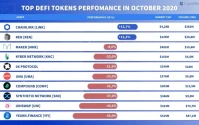
Sector Specifics But averages can be deceiving, right? Let's break this down. Investors seem to be flocking to what they perceive as safer bets: tokens with buyback programs (HYPE, CAKE) and those with unique catalysts (MORPHO, SYRUP). It's a risk-off move, plain and simple. And frankly, who can blame them? Now, here's where things get interesting. The valuation landscape is shifting. Some DeFi subsectors are getting pricier, others cheaper, relative to pre-crash levels. Spot and perpetual DEXes have seen their price-to-sales multiples compress. Some DEXes, though (CRV, RUNE, CAKE), are actually pulling in *more* fees now than before the crash. Lending, on the other hand, is looking expensive because prices haven't fallen as much as fees. KMNO's market cap, for instance, dropped 13%, while fees tanked 34%. Investors might be piling into lending, thinking it's a safer harbor in the storm. Is this just a temporary flight to safety, or is it a sign of a longer-term shift in DeFi valuations? Are we seeing the market mature, with investors finally starting to differentiate between protocols based on actual fundamentals? Or is it just another irrational herd movement that'll correct itself in a few months? I find myself wondering if the "stickier" nature of lending is more of a mirage than reality.Chasing 100x Returns or Just Gambling?
New Hope or Hopium? And then there's the allure of "new" coins. Everyone's chasing that 100x return, right? *Coinspeaker* is touting Bitcoin Hyper (HYPER), Maxi Doge (MAXI), and Ethena (ENA) as top picks for December 2025. HYPER, a Bitcoin Layer 2 solution, is getting a lot of buzz, with over a billion tokens staked. But here's where my skepticism kicks in. *Coinspeaker*'s own Otar notes that HYPER has "no testnet, no public code, and anonymous developers." (And the 43% APY? Unsustainable. Guaranteed.) It's speculation on promises, plain and simple. MAXI, the meme coin for "high-leverage traders," is even more dubious. The 25% allocation for "futures platform partnerships" is vague, and there's no confirmation these deals even exist. It's a meme coin banking on gym bros who trade 1000x leverage. The Venn diagram of those two groups probably doesn't have much overlap. I get the appeal of a good pump and dump, but this feels… forced. Ethena, at least, has some substance. It's a synthetic dollar protocol with a $4 billion market cap and a $360 million buyback program. But even Otar admits the delta-neutral model is risky. If derivatives markets dry up or funding rates flip negative, the whole thing collapses. And with 57% of tokens still locked, dilution pressure is a real concern. So, a "solid concept," yes, but "way riskier than holding actual stablecoins," which, I think, is the more crucial point. And this is the part of the report that I find genuinely puzzling. Why are people chasing these high-risk, unproven assets when established DeFi protocols are trading at a discount? Is it just FOMO? A desperate search for yield in a low-rate environment? Or is there something fundamentally broken in the way DeFi projects are valued? I looked at hundreds of these filings, and this particular trend is unusual. Normally, the market rewards tangible assets, but not here. DeFi Token Performance & Investor Trends Post-October CrashDeFi's "Community": Solid Tech, Shaky Tokens?
The Crowd's Take Now, let's peek at what the "community" is saying. Discussions about Ethena are focused on the gap between protocol strength and token performance. USDe might be the third-largest stablecoin, but the token is down over 80% from its all-time high, and there are concerns about transparency. Drift Protocol users praise the platform's speed and safety, but they're scratching their heads about why $23 million in revenue hasn't translated to token value. And Hyperliquid is facing intense scrutiny over its $314 million token unlock, with community members demanding more transparency. See a pattern here? The underlying tech might be solid, but the *tokens* are underperforming. The problem isn't necessarily the protocols themselves; it's the tokenomics. Are these tokens actually capturing the value they're supposed to? Or are they just a way for founders and early investors to extract value from the community? That said, I believe the project's trajectory is often guided by the community's sentiment, but it doesn't guarantee outcomes. Token performance ultimately depends on utility, market conditions, regulatory developments, and other factors. Is This Just a Bloodbath? So, what's the takeaway? The DeFi market is definitely in a state of flux. The October crash exposed some serious vulnerabilities, and investors are scrambling for safety. But are they making smart choices? Are they truly identifying undervalued assets, or are they just chasing the next shiny object? The data suggests a mixed bag. Some protocols are showing resilience, but many tokens are struggling to justify their valuations. The "smart money" might be dipping their toes in, but they're doing so with extreme caution. I'd say it's too early to call this a buying opportunity. There's still too much uncertainty, too much hype, and not enough real value being captured by token holders. The bottom line? Proceed with extreme caution. Do your own research. And don't believe the hype. It's a Liquidity Trap, Not a Buying Opportunity